WEPAAAA! Godzilla picked New York like the rent, the trains and the guy taking up three seats weren’t already testing everybody’s patience. Fam, you bring that radioactive foolishness into my city, somebody is absolutely going to yell at you from a fire escape. IDW’s Godzilla vs. New York City understands the comedy in that picture, but this four-story one-shot also remembers there are people underneath those falling buildings. We get monster-movie mischief, a subway nightmare, a family fighting to survive and a coffee run that goes straight to hell. Big G came hungry. New York brought attitude.
This installment of Godzilla vs. America lets its creators run in different directions, and thank goodness for that. Four versions of the same skyline getting stomped would have worn thin fast. Instead, the book moves from Frank Tieri and Mark Texeira’s black-and-white “Kingzilla” to Tango’s “Watermarked,” Anthony Marques and John Renner’s “Best-Laid Plans,” and Anna Meyer’s “Party Crasher.” The switch-ups keep the destruction fresh, although the jump from terrified families to breezy social comedy can feel like somebody changed the channel while you were still holding your breath.
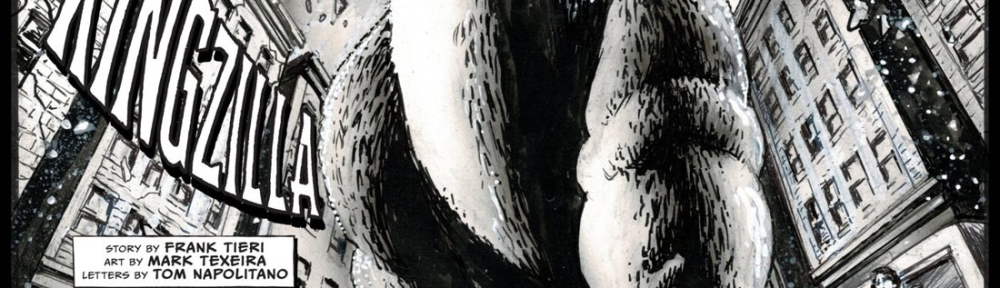
Tieri starts “Kingzilla” in 1933 and gets wonderfully disrespectful with the familiar King Kong setup. Carl Denham, Ann Darrow, the mysterious island, the promise of a sensational attraction: you know the furniture. Somebody replaced the gorilla with a tenant who has absolutely no interest in following the lease. Tieri plays Denham’s self-important narration against one terrible decision after another, letting his confidence dig the hole deeper. You can see the broad joke coming, sure. The pleasure is watching how badly this man misjudges the creature in front of him. Bro really thought he had this handled.

Texeira makes that opener look like an old monster picture somebody smuggled out of a haunted projection booth. His textured grays, heavy shadows and craggy creature rendering give Godzilla weight before the destruction starts. Little people look painfully breakable beside him. The upward views make the buildings feel tall, then Big G makes those same buildings look like disposable scenery. Faces carry panic without needing a balloon full of screaming, and the period trappings hold the whole gag together. A couple of dense, smoky images need an extra look, but I will take that gnarly atmosphere all day. This beast looks mean, fam.
“Watermarked” gets even closer to home. Tango writes and draws a group of subway passengers whose petty friction becomes a survival problem when water starts pouring in. We have all been on a train with somebody acting like the car belongs to their living room. Here, those same strangers have to cooperate before the whole commute turns into a tomb. The dialogue keeps its irritation and humor while the danger rises, so the characters don’t suddenly turn into matching disaster-movie speeches. Their personalities survive the emergency. Their chances are another conversation.
Tango’s page construction makes this my favorite story of the bunch. Tight panels trap us inside the car, close-ups track the passengers sizing each other up, and the underwater escape forces your eye through bodies, seats and rushing water. Ryan Cody’s murky greens and blue-greens make the tunnel feel filthy and airless. When the action reaches the surface, the warmer colors open the view without making the situation feel safe. Godzilla’s appearance lands harder because we have spent time down there with people who cannot simply run away. The monster gets the giant image; those commuters earned the tension leading into it. WEPA, that’s how you build a reveal.

Marques puts a father and his family through the wringer in “Best-Laid Plans,” with Renner on art and Heather Breckel on colors. A rescue becomes another emergency, and every route out seems determined to make things worse. Renner tilts the architecture and cuts across the page with slanting panels, keeping the family stranded inside a city that will not stay upright. Breckel’s cool nighttime blues give the wreckage depth, while orange light burns through the danger zones. There is some proper stomach-drop business here, especially when the characters have to move across open space with precious little between them and the street.
The family connection is immediate, though the narration sometimes tells us about fear or uncertainty when Renner has already drawn it clearly. Give those faces room, papi. We can read them. The repeated escapes also push the story toward action-movie convenience, which takes a little sting out of the peril. Still, Marques keeps the goal personal and easy to follow: get these people out alive. Godzilla can dominate a page without becoming the emotional center of every story, and this entry uses him well as the enormous threat making every human decision harder.
Meyer closes with “Party Crasher,” handling story, art and letters, and the book suddenly has jokes about friendship drama, neighborhood habits and the sacred business of getting coffee. Two women navigate a kaiju attack while their own argument keeps refusing to leave the conversation. That’s a funny choice because petty feelings do not always disappear just because life gets serious. Meyer draws them with elastic expressions and relaxed, clean lines, then drops a chunky blue Godzilla into their day like the world’s least welcome party guest. The soft colors and playful sound effects announce the lighter tone immediately.
Some readers will want a harder finish after the previous story’s family peril. I get it. Meyer’s comedy deliberately shrinks the disaster into the background of everyday grievances, and the characters’ self-absorption may grate before the punch line arrives. For me, the neighborhood specificity keeps it entertaining. The storefronts, bridge ride, coffee nonsense and stubborn conversation give the city more personality than another splash of a landmark falling over would have. New York can be exhausting even when nobody is breathing atomic fire on it. Meyer knows where to poke.

Tom Napolitano letters the first three stories, keeping the captions and exchanges readable across three very different visual approaches. His sound effects have enough muscle for the destruction without swallowing the human action. Meyer’s lettering belongs comfortably inside her own cartooning, where drawn-out roars and oversized effects become part of the joke. Nathan Fox’s cover deserves love too: those searing oranges, purples and electric greens make the Brooklyn Bridge destruction look gloriously unhinged. Brian Kolek handles design and production, with Jake Williams and Nicolas Niño editing a package that gives each team its own space.
A few familiar disaster beats and some bumpy tonal handoffs keep it from running the whole block, but the range of art, the nasty charm of “Kingzilla” and the human scramble in “Watermarked” make this an easy recommendation for kaiju fans. Fellow New Yorkers will have extra reasons to laugh, wince and argue with the page. Big G can take the skyline, fam. Somebody down below is still going to complain about the service.
CRUSADERS SCORE:
4/5
“Kingzilla”
Story: Frank Tieri
Art: Mark Texeira
Letters: Tom Napolitano
“Watermarked”
Story & Art: Tango
Colors: Ryan Cody
Letters: Tom Napolitano
“Best-Laid Plans”
Story: Anthony Marques
Art: John Renner
Colors: Heather Breckel
Letters: Tom Napolitano
“Party Crasher”
Story, Art & Letters: Anna Meyer
Design & Production: Brian Kolek
Editors: Jake Williams & Nicolas Niño
Publisher: IDW Publishing
Powered by WPeMatico