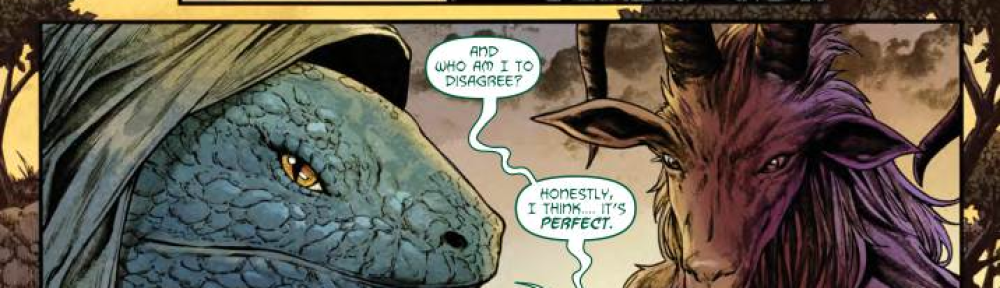
WEPAAAA! Eden has unlimited food, no bills and nobody worrying about getting old, and these people STILL found a way to turn the place into a disaster. The Serpent’s Vine had me looking at Felix like, bro, can you go five minutes without making somebody else’s day worse? Matthew Medney and Stefan Petrucha take Adam, Eve, a serpent and a supposedly perfect world, then let the humans start wrecking it. There’s an interesting argument about creativity and mortality underneath all the bruises. There’s also a beautiful-looking garden full of people I wouldn’t leave unattended with a stick. This one’s for adults, Crusaders, with nudity, sex and graphic violence throughout.
Luce, the serpent who created Eden, thinks he’s made something wonderful. His adviser Atticus isn’t entirely convinced the job is finished. The humans have everything they need and plenty of time to enjoy it, but Adam is miserable, Eve is trying to make pictures, and Felix is testing how much trouble he can cause without consequences. Medney and Petrucha let the jokes arrive early. Adam has figured out fermented fruit, which seems about right for a guy discovering he can spend eternity avoiding his problems. Eternity is a long time to be stuck beside that dude at a party.
The early violence is ugly and ridiculous on purpose. Somebody gets hurt, recovers and carries on, while Felix treats the whole business like a new toy. You understand quickly why a world without lasting consequences could go wrong. He grins through things that should make him stop. The artists draw those grins big enough to make you want Eve to hand him a very firm answer. Once pain and death start working differently, though, the joke gets harder to laugh at. The people haven’t suddenly become wiser just because their bodies have become easier to damage.

Adam and Eve gave me more to hang onto than the argument over whether paradise needs an expiration date. Eve has an image in her head and can’t figure out how to get it onto the rock. Adam has words but keeps retreating into himself. They’re recognizable frustrations for anybody who’s tried to make something and hated the first attempt. Petrucha’s dialogue gives them room to be impatient, sarcastic and affectionate. Eve especially gets some good responses to the nonsense around her. She can care about Adam without having to flatter him every time he opens his mouth.
The cave-painting sequence is where I really settled into their story. Eve’s pictures take over the pages while Adam finds words to go with them. You’ve spent time watching these two struggle to express themselves, and now you get to watch them make something together. The rough figures and animals on the wall look completely different from the polished bodies walking through Eden. I wanted more of this. Their storytelling gives us a reason to care about the book’s ideas beyond somebody explaining what humanity is supposed to learn. Let me see the first artist get excited about a picture. I’m right there with her.

Luce is interesting because he’s proud of his work and still capable of doubting it. Atticus can question him without every conversation immediately becoming a thunderous declaration. Their early exchanges have a tired-friends quality that made me smile. Later, when their responsibilities get uglier, that familiarity helps. The golden Cherubim are another matter. They look magnificent and threatening, which makes their attempts to enforce order feel like a terrible sign for everybody standing below them. Nobody in this garden handles being told no particularly well. The humans certainly don’t have a monopoly on bad decisions.
Shoby Kaneshigue draws the opening stretch, and Matteo Gennai takes over later. Kaneshigue gives the first encounters a heavily shaded, muscular look, with close-ups that make every smirk and flash of irritation obvious. Gennai’s later faces and action are drawn differently enough that I noticed the handoff, especially around Adam and Felix. It didn’t throw me out of the book. Both artists keep the cast expressive, and the later confrontations give the page more room to open up. Gennai’s cover deserves a look, too. The hooded serpent, flowers and stained-glass design make an excellent invitation into this very strange garden.
Marcio Freire’s colors do a lot to keep Eden feeling like one place across the change in artists. The opening landscapes have warm light, deep green growth and water everywhere. Storms dirty that beauty up before the fires and golden figures start dominating the page. Some of those larger images are gorgeous. You can see why Luce would be proud of the place. You can also see the damage once his creations start fighting through it. The cave paintings stand out again here, with earthy colors and worn-looking surfaces that make the pictures feel handled and made rather than magically perfect.

Dave Sharpe has plenty of personalities to keep separate. Luce’s green lettering and Atticus’s red give their exchanges an immediate difference, while the humans mostly speak through straightforward white balloons. The speech is easy to follow even when several people are arguing. The jagged effects suit the increasingly vicious physical comedy. Saida Temofonte’s title design and Mohamed Samah’s stained-glass credit and bonus pages give the book a handsome finish. I liked having the cast framed that way, especially after spending so long with them bruised, angry or running through the rain.
My biggest gripe is Felix. He’s effective, but we get a lot of the same grin, another cruel idea, another person hurt. I understood how dangerous he was well before the book finished proving it. Several of the other humans also remain more like a crowd than people I know, which weakens some of the later danger. The closing explanation of why mortality creates meaning presses the argument pretty firmly, too. I can appreciate the story and still question whether endless life would leave everybody empty. Adam and Eve’s scenes convinced me more than the extra explanation afterward.
Medney and Petrucha give the artists a wild world to draw, and the friendship, frustration and creativity between Adam and Eve kept me reading through the uglier behavior around them. Kaneshigue, Gennai, Freire and Sharpe deliver plenty of memorable pages. Some repeated brutality could’ve made room for more character work, particularly for Eve making art. Still, fam, this book gave me something to argue with after I closed it. I wanted Adam and Eve to keep creating, wanted Felix nowhere near them, and definitely wanted somebody to reconsider who was running this garden. Paradise needs better supervision.
CRUSADERS CORE:
3.5/5
Creator: Matthew Medney
Story and Writing: Stefan Petrucha and Matthew Medney
Art (story pages 1-40): Shoby Kaneshigue
Art (story pages 41-104): Matteo Gennai
Colors: Marcio Freire
Letters: Dave Sharpe
Editor: Steve Orlando
Cover Art: Matteo Gennai
Title Design: Saida Temofonte
Credit and Bonus Page Art: Mohamed Samah
Book Packaging: Mohamed Samah
Distributor: Macmillan
Publisher: GUNGNIR
Powered by WPeMatico